KLIK / 007 / job search
AI Job Search: prepare a tailored application without inventing a career
Set up AI Job Search privately: assess postings, tailor resumes, and prepare for interviews while managing API costs and personal data.
 Hamza Elmakhfi

You find a suitable job, but your general CV emphasizes everything except what the posting asks for. You rewrite the cover letter, change the CV heading and later forget which version went where. AI Job Search organizes this around a profile and workflow: assess fit, prepare an application and review it before sending.
It is not a recruiter or a promise of interviews. It is an independent open framework built primarily around Claude Code. The former MadsLorentzen repository now redirects to ai-job-search-dev. Use that official destination. This guide follows documentation reviewed on October 25, 2026; we did not submit real applications as part of this review.
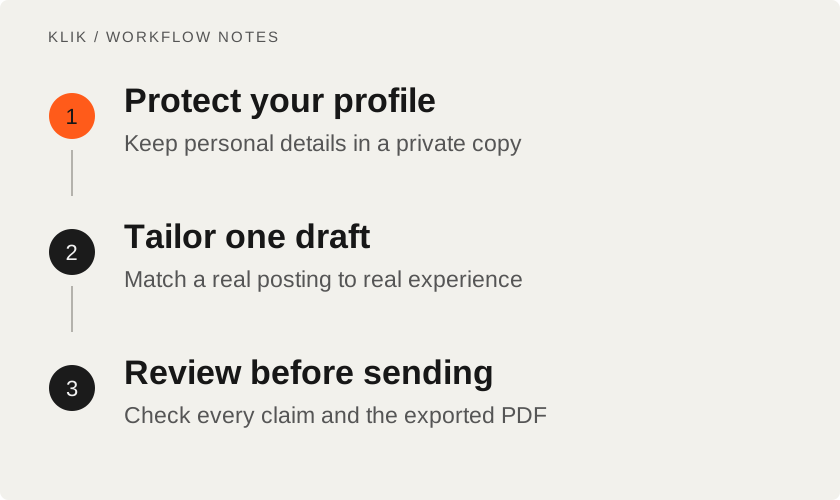
Protect the profile before adding it
The README warns that forks of a public repository remain public, and /setup writes personal details into Git-tracked files. Pushing personalized changes to a public fork can expose contact details, experience and other profile information.
For personal use, follow SETUP's private-repository-with-upstream approach or keep a local copy without pushing. Inspect the actual files before any synchronization. Some documents and tracker files being gitignored does not make the whole profile private. Also confirm the GitHub CLI's destination repository before creating issues containing application information.
Understand what transfers to your market
The core workflow supports profiling, evaluating a posting, tailoring a CV and cover letter, and preparing for interviews. Tracking applications can reduce repeated context entry. Results still depend on an accurate profile and a real job description.
Several supplied portal-search integrations focus on Denmark. Evaluation and writing can be adapted across countries and languages, but that does not establish automatic support for Moroccan job boards. Start with a real official posting and confirm access is permitted without bypassing logins or service rules.
Requirements and costs
The primary path needs Claude Code with an eligible account or API credits. The project is independent of Anthropic. It lists Python 3.10+, Bun for search tools and a LaTeX distribution for stock PDF templates. Current documentation uses lualatex for the CV and xelatex for the cover letter.
This text workflow does not require a local GPU model, but the computer must support the selected tools and compiler. SETUP covers Windows, macOS and Linux and additional packages for smaller TeX distributions. The documentation does not give one RAM requirement for all these tools; check each tool before installation. The project documents adaptations for other agents, but those may work differently from the Claude Code setup.
The framework's MIT license is separate from agent subscriptions or model charges. Reading documents, assessing many postings and repeated drafts increase use. Test one posting before a large batch.
Prepare a private working copy
- Read README and SETUP, particularly private repository guidance, before adding a name or CV.
- Create a separate private copy through the documented process. Check remotes and every push destination. Keep public contributions separate from personal applications.
- Install Claude Code, Python, Bun and TeX for your platform. Test compilation before a time-sensitive application.
- If portal CLIs are needed, run the repository's documented installer from its directory:
python3 tools/install_portal_clis.pyThe README's Windows form is:
python tools\install_portal_clis.py- Open Claude Code in the directory and run
/setupinside the agent. That is not a PowerShell command.
Onboarding can use a documents folder, pasted CV or interview. Supply necessary material only, removing unrelated identifiers. A local repository does not imply a local model: a cloud agent may receive the files it reads.
First use: one posting, evidence for every claim
Choose an official posting and request an assessment against the profile. Separate essential requirements, preferences and missing information. A fit score is an organizing aid, not a measured probability of being hired. Confirm location, language and authorization requirements in the original posting.
Use the documented /apply workflow with the real URL to produce a draft, then read every line. Delete invented leadership, technologies or experience and correct the profile that caused them. Tailoring means emphasizing relevant experience, not creating a different career.
Inspect the PDF visually and check that its text can be read and copied in a sensible order. A good screenshot can hide poor parsing. The optional pypdf ATS check and documented fallback help inspect output; neither guarantees how every employer's screening system will rank it.
Search and follow up without flooding employers
/scrape and /rank help find and prioritize postings through supported paths. Do not equate a high score with a suitable application. Check the company, source and posting date; a search summary can describe a closed role or omit important conditions.
Keep submission under human control and record the version and date sent. This avoids inconsistent answers later. Gmail and Notion integrations are optional. Review permissions and need before connecting personal accounts through OAuth.
Prepare for the conversation
Compare a draft with the original CV, rather than only with another generated version. Ask which experience supports each skill and whether every number can be explained. If wording exaggerates a real responsibility, bring it back to the work actually performed. Then read the letter aloud: if it uses words you would never say in an interview, edit it until it sounds like you. A high score does not mean the text represents you.
Use /interview to turn role requirements into questions about genuine experience. Practice in your own words and identify what you still need to learn. A follow-up question can quickly expose a memorized answer you cannot explain. Preparation should help you explain your background, not perform expertise you do not have.
AI Job Search suits deliberate applications that you will personally review. For simply compressing a CV or combining attachments, Stirling PDF may cover the technical task. Hiring still depends on experience, market conditions and employer decisions, rather than the name of the tool used.
Keep reading
All KLIK guides
KLIK / 003coding agents · English
Best Vibe Coding Tools & Workflows: From Questions to Tested Code
A field-tested comparison of the best vibe coding tools—Grill Me, Superpowers Brainstorming, Mobbin MCP, Ponytail, and Context7—with practical workflow stages, a comparison matrix, and real production limitations.
KLIK / 008Paperclip · English
Paperclip: coordinate agents, tasks and budgets without the autonomous-profit claim
Start Paperclip locally with one agent, a narrow goal, approvals and budgets. Understand the coordinator, external runtimes, permissions and operating costs.
KLIK / 010Stirling PDF · English
Stirling PDF: combine and review documents while knowing where processing happens
Install Stirling PDF for merging, OCR, and redaction. Understand Local Only vs Cloud processing, privacy boundaries, and licensing.